
The Village Museum of Curtișoara is one of those places in Romania that feels like it’s been lifted straight from a fairytale. Nestled in the heart of Oltenia, in the country’s southwest, this open-air museum—known in Romanian as Muzeul Satului—offers a peaceful and evocative glimpse into rural life. While it may be smaller than the more famous Village Museum in Bucharest (which I wrote about here: Bucharest Village Museum, it holds its own charm and character. The Village Museum of Curtisoara, with its traditional homes on display, is just as stunning, each lovingly preserved and rich with history.
A Walk Through the Present Past
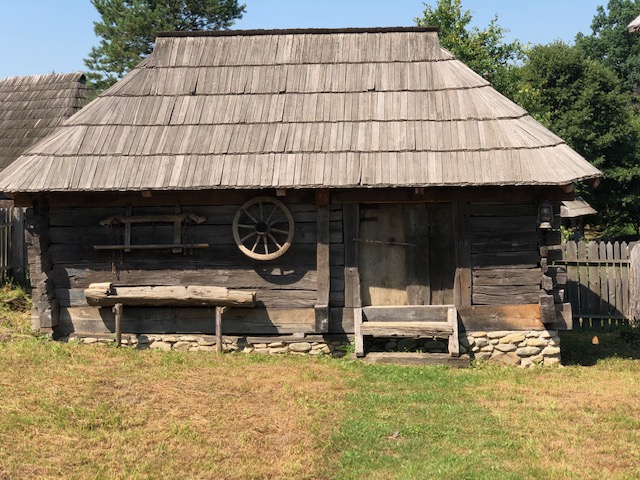
Curtisoara Village Museum represents houses that were traditional in Oltenia. What makes this place truly special is not just the beauty of the architecture, but the journey it took to get here. Many of the homes you see here were carefully dismantled from their original locations. Some of these houses are dating back to the 1700s! Then they rebuilt with precision on new foundations using the very same traditional methods by which they were once made. It’s a quiet act of preservation that feels almost sacred.


Walking among these homes, I was struck by how familiar they felt. Despite being centuries old, houses like these are still lived in today in rural corners of Romania. In fact, if you drive a few kilometers out of town, you might just be invited in for țuică by someone living in one. They don’t feel like relics of the past, but rather like slightly creaky grandparents—still standing strong, full of stories, and just a bit stubborn about modern plumbing.
Inside the houses
Some of the houses at the Village Museum of Curtișoara are open to visitors, offering not just a peek, but a passage into the rhythm of rural life as it once was—and in some places, still is. Stepping inside, you’re met with a warm, lived-in simplicity. Looms sit patiently in corners as if someone had just gotten up to fetch more thread. Clay pots and hand-carved wooden spoons rest on open shelves. Embroidered linens, with delicate red and black patterns, cover tables and beds, each stitch a quiet act of artistry passed down through generations.


In one of the rooms, I came across a “ladă de zestre”—the traditional dowry chest. Painted in rich colors, it once held not only linens and blouses but the hopes and labor of a young girl’s future. These chests were more than storage; they were treasure boxes of identity, family, and love. Seeing them in their original setting, not behind glass, felt surprisingly moving. There’s something deeply human in witnessing the care and pride with which people prepared for the milestones of life.
One of the most striking displays was a loom, with a mannequin seated in front of it, dressed in full national costume. She was positioned mid-weave, her hands poised as if she’d only paused for a moment to catch her breath. It was easy to imagine the quiet rhythm of weaving filling the room, the soft creak of wood and the steady pull of yarn.
The national costumes were stitched by hand, often by the women who wore them. Tthese outfits aren’t just beautiful—they’re full of meaning. Each pattern and color signaled something about the wearer: where she was from, her marital status, even her mood for the day. Looking at them hanging neatly on display, I tried to imagine how it must’ve felt to wear one on a holiday or for a village dance. Idyllic, yes—but also full of care, and intention. These were clothes meant to last, to tell stories, to be remembered.

From the outside
Not all houses are open for interior visits. But even the closed ones enchant from the outside. Some are wrapped in ivy or shaded by fruit-laden trees, their wooden porches scattered with woven baskets and rustic stools. You can almost hear the soft murmur of conversation, the creak of floorboards, the hiss of something simmering on a wood-fired stove.


What photos can’t fully capture is the feeling of being there: the breeze rustling through the leaves, the scent of wild herbs in the air, the stillness of the hills. It is peaceful and grounding, like stepping out of time. A reminder of what simplicity once meant—and still can. Not far from one of the old cottages, I found a shaped Romanian haystack, we call it căpiță de fân. It looked like something from a childhood storybook—golden, with the that smell of grass and summer. I half expected a dog to be napping beside it, or a grandmother calling out for someone to come help cover it with a tarp before rain.


The church – Tatarascu
Together with the historic houses, one of the most intriguing landmarks on the site is a small wooden church that once belonged to Gheorghe Tătărescu, a prominent Romanian statesman who served as Prime Minister during the interwar period. Tătărescu was known for his diplomatic finesse and modernization efforts, trying to steer Romania through a volatile political landscape. He supported cultural and economic reforms and was once a close ally of King Carol II. But like many figures of that era, his fate shifted drastically—after World War II, when the communists came to power, Tătărescu was marginalized, arrested, and eventually removed from all political life. His legacy was buried for decades, just like the histories of so many places and people associated with the old Romania. Just like it happened with my family’s history ……
The church he once owned feels almost like a metaphor for that forgotten past. It’s small and humble inside, but full of soul. The original wooden furniture is worn smooth by time and prayer, and a faint scent of incense still lingers in the air.
When our guide tapped the church bell(picture below)—an elegant piece imported from Italy—it rang with such clarity that it seemed to ripple out across the hills. For a moment, I imagined it ringing decades ago, calling a rural community together, or echoing in solitude when no one remained. Standing there, you feel how deeply rooted faith and tradition are in these lands.


Tips for Visitors
1. Take your time—don’t rush the experience.
The Village Museum of Curtișoara is not huge, but it invites a slow, thoughtful pace. Plan for at least 1–2 hours to explore the grounds, peek inside the open houses, and soak in the atmosphere. If you’re someone who loves history, folk art, or photography, you might want even longer.
2. Bring water and wear comfortable shoes.
The grounds are grassy and uneven in parts, especially around the older homes and near the orchard area. Sneakers or walking sandals are best. There’s not always a place to buy refreshments, so bring water—especially on a hot day.
3. Chat with the guide, if there is one.
Local guides (when present) are full of knowledge and often have great stories about the history of the houses or the people who once lived in them. Ask them about the church bell, the haystacks, or the loom inside one of the homes—you’ll likely get an unforgettable anecdote.
4. Check seasonal hours and events.
The museum may have limited hours during off-season months, and sometimes it hosts local events like traditional music performances, exhibitions, or craft fairs. If you’re lucky enough to catch one, it adds an extra layer of magic.
5. Bring a camera—and maybe a journal.
The textures, colors, and quiet charm of the place make it a dream for photography. But it also inspires reflection. If you enjoy writing, sketching, or simply sitting under a tree with your thoughts, this is the place.
What to Explore Nearby
• Târgu Jiu – The Brâncuși Sculptural Ensemble
Only a short drive away is the town of Târgu Jiu, home to the world-famous outdoor sculptures of Constantin Brâncuși: The Endless Column, The Table of Silence, and The Gate of the Kiss. These are must-sees—powerful, poetic, and rooted in this region’s soul.
• Polovragi and Horezu Monasteries
If you’re drawn to spiritual sites, these two nearby monasteries offer peace, history, and stunning architecture. Horezu is a UNESCO World Heritage Site and also famous for its pottery.
• Peștera Muierilor (Women’s Cave)
Located near Baia de Fier, this cave is one of Romania’s natural wonders, rich in legends and incredible limestone formations. Great for kids and adults alike.
• Transalpina Road
If you’re visiting in the warmer months, take a drive along the Transalpina, Romania’s highest road. It passes through the heart of the Parâng Mountains and offers jaw-dropping alpine views—not unlike the famous Transfăgărășan.
• Local food and crafts
Don’t leave without tasting sarmale (cabbage rolls), bulz (polenta with cheese), or plăcintă cu brânză (cheese pastry). Many villages nearby still practice traditional crafts—woven rugs, carved wood, and handmade ceramics can all be found if you ask around or visit local markets.
If stories like these stir something in you—nostalgia, wanderlust, or just the joy of discovering hidden gems—then let’s stay in touch!
Subscribe to my blog for more soulful travel tales, personal reflections, and tips from places that feel like they belong in fairytales. I’d love to have you along for the ride. 🌍






Leave a Reply