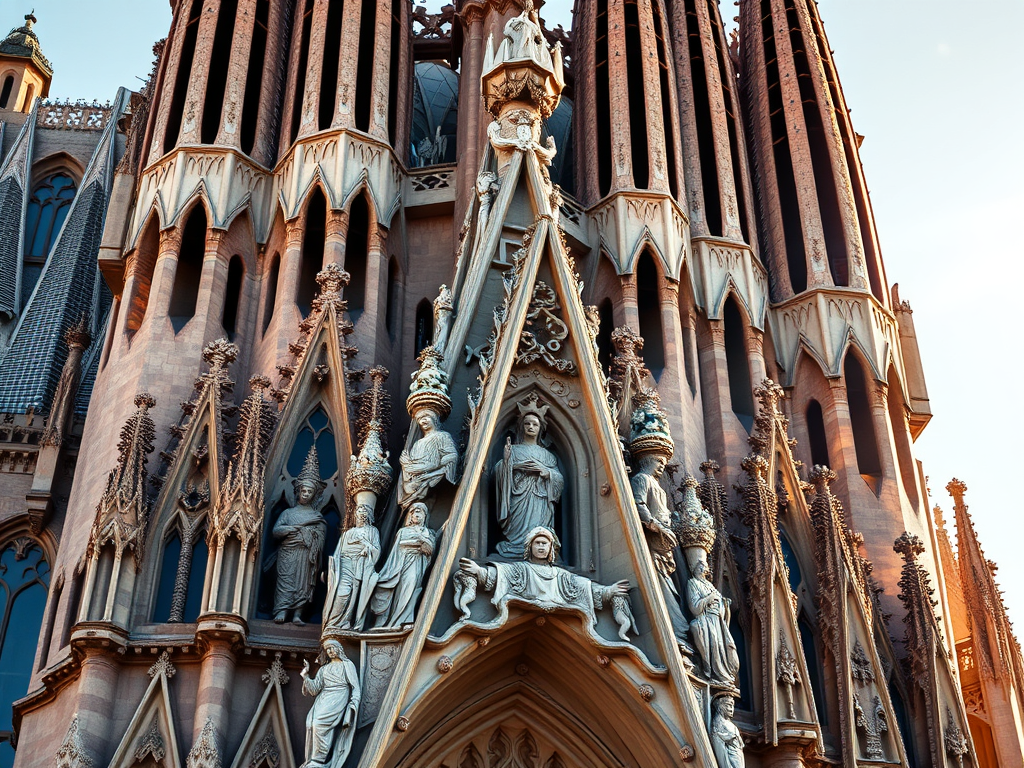

I looked up, and the towers were still climbing. Stone and sunlight braided themselves into something that felt alive—La Sagrada Família, Barcelona’s unfinished heartbeat, rising in scaffolds and sky…..
II visited Spain—and Barcelona—in a month of March. Yes, I say a month of March to mark the season, because it was a while ago. The weather was unusually sunny; a perfect time to gallivant around the city.
One of my first walks had a destination. I woke early; my mom was with me, and together we set out for La Sagrada Familia. The city breathed its perfume—salt from the sea, fresh coffee and warm bread, and a veil of stone-dust that clings to a city endlessly rebuilding itself. The cranes sang their mechanical lullaby, a distant beesong that said: this is still being born. And then the light thinned into morning, and I looked up—La Sagrada Familia rising above Barcelona’s grid, its spires like winter branches reaching for a spring they could already feel.
The Story of La Sagrada Familia — Faith in Stone
La Sagrada Familia is a place of imagination, faith, and perseverance — a structure that refuses to be hurried by time. Rising from the heart of Barcelona, this gigantic Roman Catholic basilica has taken shape over more than a century, and even now, its towers’ stretch toward the sky it has not been completed.
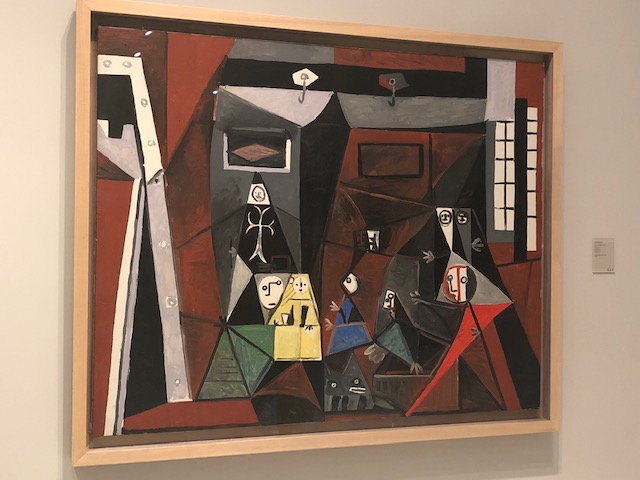
This is not just one masterpiece standing alone. Across Barcelona, you can trace the same conversation between art and devotion—from the playful mosaics of Park Güell to the quiet, introspective rooms of the Picasso Museum, where the city’s soul speaks in line and color.
The story began in 1882, when construction started under architect Francisco de Paula del Villar, who envisioned a traditional neo-Gothic design. But destiny intervened the following year, when a young and unconventional architect named Antoni Gaudí took over the project. What he created from that moment forward was something no one had ever seen before — a cathedral that seemed to grow organically, as if born from the earth itself.
Gaudí devoted 43 years of his life to La Sagrada Familia, the last 15 entirely to it. He lived and breathed the basilica, moving into a small workshop on site so he could watch over its progress daily. He once said, “My client is not in a hurry,” referring to God — and indeed, time has proven him right.
When Gaudí died tragically in 1926, only a small fraction of his masterpiece was complete. The Nativity Façade, radiant with joy and life, stood as a promise of what was to come. Decades of political turmoil, civil war, and shifting technology followed, yet the vision endured. Builders and artisans carried on, guided by Gaudí’s detailed models and sketches, many of which had been burned during the Spanish Civil War and painstakingly reconstructed later from fragments.
Through the years, cranes became as much a part of Barcelona’s skyline as the basilica’s towers themselves and each generation of architects inherited not just blueprints, but a mission: to translate Gaudí’s faith and genius through the evolving language of modern engineering. As I stood in front of it, over 140 years later, the basilica still hummed with the sound of chisels and drills, a slow heartbeat of creation. The latest projections aim for completion in 2026, marking the centenary of Gaudí’s death — though even then, the surrounding plazas, stairways, and ornamental details will take several more years to finish.
Gaudí’s Lifelong Devotion
Inside the visitor center, I stopped in front of the makete — the large architectural model of La Sagrada Familia. I remember raising my camera, trying to capture what words couldn’t quite hold. In the model, the finished sections were painted in warm ochre, while the parts still in gray marked the unfinished dream. It was humbling to see how much had been completed and how much still waited to rise. Yet standing there, it didn’t seem to matter. Even in its incompleteness, the basilica radiated something whole — a beauty that felt alive, a presence that needed no perfection to be complete.

I felt as if I was looking at Antoni Gaudí’s soul in stone. The soul of a sculptor of faith, of a mathematician of nature, and of a dreamer who believed that beauty itself could lead people toward God.
I hear that as his fame grew, his life became simpler. He withdrew from social circles, sold most of his possessions, and eventually moved into a small workshop on the construction site so he could watch over every detail.
He never married. His one love, Josefa Moreu, a young woman he met early in his career, did not return his feelings — and from that heartbreak emerged a quiet vow of dedication. He once said that love could take many forms, and his became one of creation itself. The basilica became his companion and his lifelong conversation with the divine.
Inside La Sagrada: Facades and Detail
La Sagrada looks almost like a giant piece of jewelry! There is so much work and detail in every part of the building. There are three facades, each of them built in different time periods, and you can tell that by their color and their style. Only one —the Nativity Façade (constructed between 1894 and 1930) —was completed by Gaudí himself. I loved it the most! This façade has a lot of life, and many artists and sculptors collaborated with Gaudí to decorate it. If you go visit, take time to view it and understand it.


The other two facades, the Passion Façade and the Glory Façade, are also beautiful. The Passion Façade is more austere and simple. The Glory Façade is not ready yet, but I have read that it will feature constructions shaped like clouds that will rise through the four bell towers (the towers symbolize Saint Andrew, Saint Peter, Saint Paul, and Saint James). These clouds will surround an image of God, and the façade will be seen from the sea. Imagine that!
When ready, the highest tower of La Sagrada will be 170 meters tall! What is interesting is that Gaudí believed that nothing man-made should ever be higher than what God has created. So 170 meters is only one meter less than Montjuic, the mountain in Barcelona, which is the highest point in the city!


The interior of La Sagrada is based on nature, because Gaudi wanted to build things that resembled nature. It is a pure example of biomimetic architecture, although this is a contemporary philosophy of architecture and Gaudi is a precursor. If you don’t know, biometric architecture uses nature inspired designs to create an organic architectural flow.
When inside, I just wanted to stay there for a while! I didn’t know where to look first and what to admire. The columns resembled threes, with branches and leaves. The light was coming from different windows and it was creating this spectacle of colors. The light reflections on different parts of the church gave the columns different colors.
Where Gaudi Rests: A Prayer Beneath Stone
Down a quiet stairway, beneath the soaring spires and stained-glass glow, lies the resting place of Antoni Gaudí — the man whose imagination gave birth to La Sagrada Familia. His tomb rests in the crypt of the basilica, in a small chapel dedicated to the Virgin of El Carmen. It is modest, carved in pale stone and lit softly, as if the entire cathedral bows its head there.
I stopped before it and felt the air change. The noise of the world above — the cranes, the visitors, the hum of a city alive — faded into a silence that was almost sacred. I said a quiet thank you to him, not just for the beauty of the basilica, but for what it represents: a life lived with unwavering faith in art, in creation, in something greater than the self.

Gaudí was killed in June 1926, struck by a tram while walking through Barcelona. Dressed in his worn clothes, with no identification on him, he was mistaken for a beggar and taken to a public hospital. When his friends finally found him, it was too late. He died three days later at the age of seventy-three — humble, poor, and utterly devoted to the work he would never see finished.
There is something hauntingly poetic about that. The man who spent his life building a bridge between heaven and earth died on an ordinary street, returning — as we all do — to the ground. And yet, his dream did not die with him. His apprentices, his sketches, his vision carried on, each generation adding stone upon stone, faith upon faith.
Standing by his grave, I thought about how few people ever see the full arc of what they begin. But I think that creation is not about finishing, but about believing — about giving everything you have to the work that calls you,
I whispered another thank you, and I left……my soul colored by his art.
Every visitor carries a different question into La Sagrada Família — some practical, some spiritual. The longer you stand beneath its vaults of light, the more you realize this place isn’t just a landmark; it’s a conversation between time and faith, between creation and patience. Here are a few answers to the questions people often ask — and perhaps the ones that linger silently in all of us.
Because Gaudí envisioned a cathedral that would grow with time itself. Construction began in 1882, and each generation adds its own touch. Its unfinished form has become part of its soul — a living reminder that beauty can exist even in progress.
Every column and color carries meaning. Inspired by nature, Gaudí designed trees instead of pillars, light instead of walls. Step inside, and you feel less like you’ve entered a building and more like you’ve stepped into sunlight made solid.
Early morning or late afternoon — when the stained glass scatters its colors across the floor like liquid fire. The light itself becomes part of the architecture, shifting with the day, retelling Gaudí’s vision in every hue.
Look up. The ceiling opens like a forest canopy. Each shape and spiral leads the eye toward heaven, not through grandeur but through grace. Let the silence do the rest — that’s where the real story lives.
That both are acts of faith. Every stone laid here is a promise — that patience, devotion, and imagination can turn centuries into a single heartbeat.
Plan for at least two hours — enough time to move slowly, let the colors change, and feel the rhythm of the space. If you linger, you’ll notice how the light itself shifts like a conversation — from gold to violet to quiet.
Absolutely. You don’t have to believe in a faith to feel the sacred here. The language is universal: light, sound, color, time. Whether you call it devotion or design, the experience is one of awe — an invitation to wonder.