

A summer morning at St. Paul’s Cathedral felt less like sightseeing and more like stepping into a quiet dream — one woven from light, stone, and centuries of history.
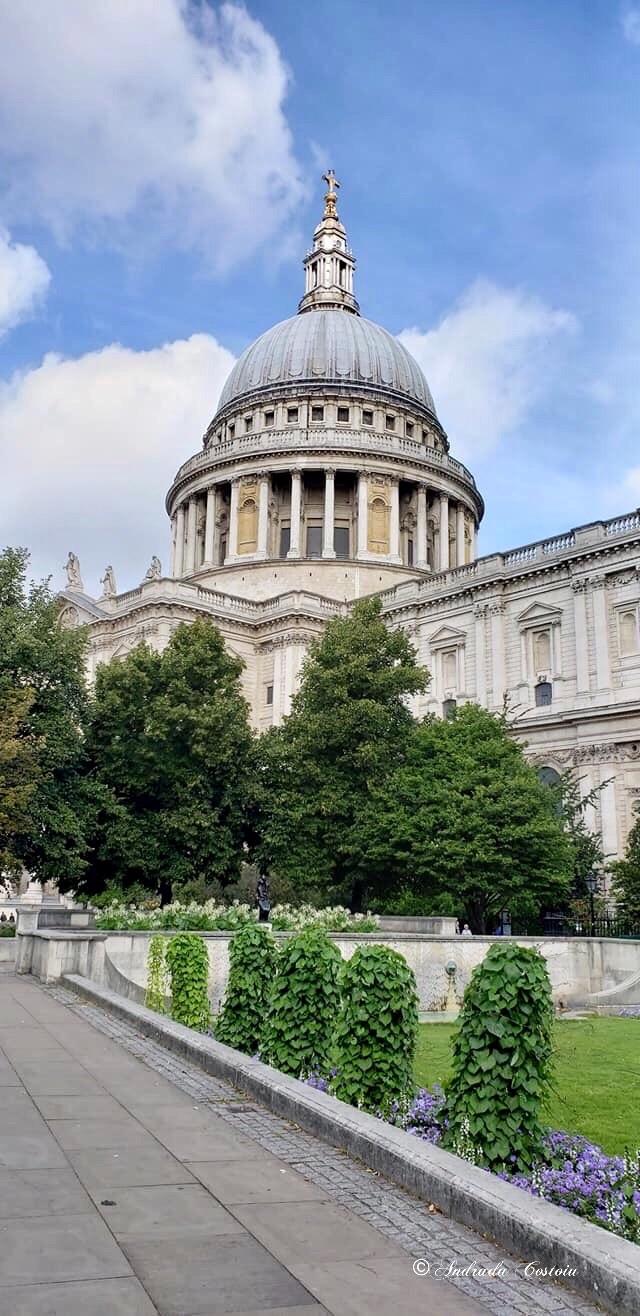
It was a quiet morning in London — the kind where the air carries a hint of sun-warmed stone and the hush of the city waking slowly. The trees lining the walk toward St. Paul’s cast dappled shadows across the pavement, their leaves whispering in a soft breeze that smelled faintly of rain and roses from a nearby garden square. The cathedral’s dome rose ahead, luminous in the early light, its silhouette cutting gently into the sky like something imagined before it was built.
I hadn’t planned to attend the morning mass. But something about the stillness drew me in — a hush that felt older than the street sounds. Whether or not you are religious, there’s a kind of reverence that lives in places like this. A quiet invitation to pause, to listen, to feel small in a beautiful way.
St Paul’s Cathedral: A bit of history
As I settled quietly into my seat and the mass began, I wasn’t quite sure what to expect. Then, there was a speaker — and though I don’t know if this is part of every Sunday’s ritual, her voice carried a power that reached deep into the heart of everyone. She invited us to journey back through the centuries — through the history of St. Paul’s Cathedral. Her words opened a door, and I found myself drawn into a story far richer and more profound than I had imagined. Moved and curious, I later set out to uncover the full tapestry of history behind this extraordinary place — and here is what I found.
St. Paul’s Cathedral is a magic place that goes back in time. I thought this building was the start, but no!! The cathedral building has been destroyed several times and there is so much history behind it! Long before the grand cathedral we see today, this spot held a Roman temple to Diana, marking it as a place of spiritual significance even in ancient times. Then, in AD 604, the first Christian cathedral dedicated to St. Paul was built here, laying the foundation for a legacy of faith. That cathedral burned and its replacement (built 675–685) was destroyed by Viking raiders in 962.
By 1087, yet another cathedral had risen on this enduring site—but like those before it, it too was lost to fire.
In its place, the fourth great church—later known as Old St. Paul’s—began to take shape in the late 11th century. It was a marvel of medieval ambition, with a spire that soared even higher than the majestic dome that crowns today’s cathedral. For centuries, it stood as a symbol of London’s spiritual heart. But fate struck again in 1561, when lightning ignited the timbered spire. Flames devoured it…. and it was not replaced. For the next century, Old St. Paul’s stood incomplete, its silhouette altered, but its presence still commanding.
That all changed in 1666, when the Great Fire of London swept through the city. St. Paul’s was engulfed in flames. Witnesses described the lead from its roof melting and pouring down the streets like a river of fire. The mighty cathedral collapsed in the blaze, clearing the way—both literally and symbolically—for the creation of something entirely new.
The St. Paul’s Cathedral we see today—majestic, enduring, and iconic—was born from the ashes of destruction. Designed by Sir Christopher Wren in the late 17th century, it was not just a building, but a bold statement of renewal. This was the first cathedral constructed after the English Reformation, that seismic moment in the 16th century when Henry VIII severed ties with Rome and reshaped the spiritual landscape of an entire nation. Wren’s vision rose not only as a place of worship, but as a symbol of a new era, one rooted in both tradition and transformation.
Built with elegance and strength, St. Paul’s would face yet another great trial nearly three centuries later: the Blitz. During the harrowing nights of 1940 and 1941, as bombs rained down over London in the German Luftwaffe’s relentless campaign, much of the city was reduced to rubble. Much of London was lost, landmarks crumbled. Fires raged. The skyline changed forever.
But through it all, St. Paul’s endured.
Images from that time show the cathedral standing proud above a sea of smoke and ruin—its great dome rising like a beacon of hope. Some say it was divine protection, others speak of the volunteer firewatchers who risked their lives on the roof to put out incendiaries. Whatever the reason, the survival of St. Paul’s became an emblem of the country’s resilience. It was no longer just a church; it was the heart of London’s courage, a spiritual fortress that refused to fall. Below is a picture of it after WWII.

From Roman temple to Viking ruin, from medieval spire to fire-scarred dome, this site has seen centuries of rebirth. And through each incarnation, it has carried the soul of a city—quietly, powerfully, forward.
Who was Christopher Wren and how did he came to build St. Paul’s?
Out of the ashes of London’s darkest hours rose one of its brightest minds. In 1665, the Great Plague swept through the city. A year later, the Great Fire consumed it—devouring homes, markets, and 88 churches in just a few furious days. It was a moment of devastation, but also a chance for rebirth.
Into this charred and grieving city stepped Sir Christopher Wren. Already known for his brilliance in mathematics and astronomy, Wren was more than just a builder — he was a visionary. A founder of the Royal Society (president 1680–82) and one of the great minds of his age, he had long been drawn to the interplay between science, beauty, and sacred space. His reputation was so respected that even Isaac Newton and Blaise Pascal admired his work.
Christopher Wren was commissioned to build 51 replacement churches, and that included St Paul’s cathedral. While many of these churches followed general plans approved by Wren, only a handful truly bear the unmistakable touch of his full imagination. St. Paul’s was his masterpiece. He didn’t just design a building. He imagined a symbol — a place where the heavens might seem closer, and where a city broken by fire could feel its spirit rise again.
St Paul’s Cathedral: A Masterpiece in Stone
The cathedral doesn’t just hold history; it is history, etched in marble and lifted into the sky.
The cathedral’s design draws inspiration from the grandeur of St. Peter’s Basilica in Rome—but it speaks in a distinctly English voice. The construction of the cathedral took more than 40 years. In 1708, Wren’s son, Christopher Wren Jr, placed the final stone on the lantern, watched by his father below.
At the heart of the design lies the breathtaking double-shell dome, a daring feat of engineering. Rising 365 feet (111 m) to the cross above, it was once London’s tallest structure and remains one of the tallest domes in the world. Inside the cathedral, you see one dome; outside, another. Between them sits a concealed brick cone and a timber-and-lead outer dome.
The dome framed by the spires of Wren’s City churches, has dominated London’s skyline for over 300 years.


The Whispering Gallery of St. Paul’s
As architectural dialogue unfolds, there is so much more here! The church is beautiful ,with impressive arches and naves.You will have to come and see it with your own eyes. But here is something that I’d like to talk about…because, you know, I am a romantic at heart.
High above the marble floor of St. Paul’s, nestled within the curve of its iconic dome, lies the Whispering Gallery—a place where sound behaves like magic. Stand at one side, speak barely above a breath, and someone 100 feet away will hear your words as if you were beside them. This acoustic wonder isn’t just a feat of engineering; it’s a place of quiet connection.

Over the centuries, it’s become a haven for lovers and dreamers. There are stories of Victorian couples testing the gallery’s secrets—sending whispered promises across the dome when society kept them apart. Soldiers on leave during wartime are said to have stood here with sweethearts, exchanging vows too fragile for the chaos outside. Even today, you might spot a pair lingering at the edge, speaking softly, smiling with eyes closed—because here, in this stone amphitheater of whispers, even the smallest “I love you” echoes like a prayer.
Coincidentally, I was reading “Letters to the Lost“, a beautifully tender love story set during WWII by Lorna Grey, when I stumbled upon a passage that stopped me in my tracks (see the picture). The scene happened in the Whispering Gallery in St Paul’s Cathedral. There, words barely spoken, traveled across distance, just as love often does.
Legend has it that Christopher Wren himself never imagined this accidental marvel that became the Whispering Gallery. Yet like many beautiful things, it came to life not through intention. A whispered word, a lingering promise, a love carried on a curve of stone—this is the soul of this place.
Who’s Buried in St Paul’s Cathedral?
Many famous figures are buried beneath St. Paul’s Cathedral, making the crypt not just a resting place, but a silent archive of British history. The first to be buried here was none other than the cathedral’s own architect, Sir Christopher Wren, who died in 1723. His tomb lies in the south aisle of the eastern crypt, marked modestly despite his grand achievement. Above it, a Latin inscription reads, “Lector, si monumentum requiris, circumspice” — “Reader, if you seek his monument, look around you.”
The crypt at St. Paul’s Cathedral itself is the largest in Europe, a vast and solemn space holding the remains of national heroes, poets, and dreamers. The most imposing memorial on the cathedral floor belongs to Arthur Wellesley, the 1st Duke of Wellington, who defeated Napoleon at Waterloo. Incredibly, his tribute took longer to construct than the cathedral itself. Nearby lies Admiral Lord Nelson, another towering military figure, who died at the Battle of Trafalgar and was honored with a state funeral.
You’ll also find tributes to iconic figures such as Florence Nightingale, this woman was a pioneer of modern nursing; William Blake, the visionary poet and artist; and T.E. Lawrence — better known as Lawrence of Arabia — whose legend still captures imaginations. Each name etched in stone is a portal into another story, another piece of the past echoing beneath the great dome.
The mass: a quiet reflection

I don’t always connect with sermons in the traditional sense — perhaps because I’ve always been drawn more to shared reflection than instruction. But what truly touched me that morning was the profound, unspoken connection among everyone gathered there. I felt the quiet strength that comes from people gathering with open hearts.
As I was siting there, listening, feeling, the chorus began.I felt overwhelmed when the chorus began to sing And just when I thought the moment couldn’t grow any more powerful, everyone joined in. Hundreds of voices rising together, filling every corner of the cathedral — and I cannot describe into words that moment of pure unity and hope.
Picture snapped by my friend while going to the mass
In that instant, I understood what it truly means to be human: to raise our voices as one, to carry each other’s hopes, and to believe in the power of togetherness.
This is a feeling that stays with me — the knowledge that while we each walk our own path, standing side by side, offering even just a small piece of ourselves, we can build something beautiful and enduring.
Tips for Visiting St. Paul’s Cathedral
If you’re planning a visit to St. Paul’s Cathedral, a little preparation can make the experience even more meaningful — and less stressful.
1. Book in Advance
Tickets can be purchased online through the official St. Paul’s Cathedral website. Booking ahead not only helps you skip the ticket queue, but sometimes also comes with a small discount. Look for combo tickets if you’re also visiting other London landmarks — they can save you time and money.
2. Consider a Guided Tour or Multimedia Guide
The cathedral offers excellent guided tours (included in the ticket price), led by knowledgeable guides who bring the building’s history to life. If you prefer to explore at your own pace, you can use the multimedia guide — available in several languages — which includes audio commentary, images, and interactive maps.
3. Don’t Miss the Dome Climb
If you’re up for a climb, ascending to the top of the dome is a must. There are three galleries:
- The Whispering Gallery, where sound travels magically along the curved walls (note: this may be temporarily closed).
- The Stone Gallery, which offers panoramic views over London.
- The Golden Gallery, at the very top, for truly breathtaking vistas — but be warned, it’s 528 steps up!
4. Visit During a Service (Especially Evensong)
Entry to services, including morning Eucharist and the beautiful Evensong, is free (no sightseeing during the service, though). It’s a unique way to experience the cathedral as a place of worship, surrounded by music and reverence.
5. Allow Time for the Crypt
The crypt is often quieter but no less impressive. Here you’ll find the tombs and memorials of some of Britain’s most significant historical figures. Don’t rush it — it’s a space that invites quiet reflection.
6. Dress Comfortably and Respectfully
There’s no strict dress code, but as it’s a functioning church, it’s best to dress modestly. And if you’re planning to climb the dome, make sure to wear shoes you can walk (and climb) in!
7. Photography Tips
Photography is allowed in most areas, but not during services. Be mindful of signs and respect the silence in designated areas. And don’t forget to look up — the ceilings and dome artwork are stunning.
8. Check for Temporary Closures or Events
The cathedral hosts state and religious ceremonies throughout the year, so parts of it may occasionally be closed. It’s a good idea to check the official website or social media channels for updates before you go.
9. Nearby Attractions
You’re in the heart of historic London. After your visit, stroll across the Millennium Bridge toward Tate Modern, or explore the charming streets around Ludgate Hill and Paternoster Square.
Share Your Thoughts & Stay Connected
Have you visited St. Paul’s Cathedral? Did you climb to the top of the dome, or sit quietly through a service like I did? I’d love to hear about your experience — feel free to share it in the comments below!
If you enjoyed this story and want more travel reflections, hidden histories, and thoughtful moments from around the world, don’t forget to subscribe. I share new posts regularly, and I’d love to have you along for the journey.
Let’s keep exploring — together.
COPYRIGHT NOTICE
© Andrada Costoiu and a-passion4life.com, 2019 . Unauthorized use and/or duplication of this material without express and written permission from this site’s author and/or owner is strictly prohibited. Excerpts and links may be used, provided that full and clear credit is given to Andrada Costoiu and a-passion4life.com, 2019 with appropriate and specific direction to the original content.







Leave a Reply